
For more than a century, the iconic dinosaur Diplodocus has been associated primarily with the Late Jurassic landscapes of North America. Its long neck, enormous body and whip-like tail have made it one of the best-known sauropod dinosaurs.
That geographical picture has now been challenged by a fossil discovery in eastern Spain.
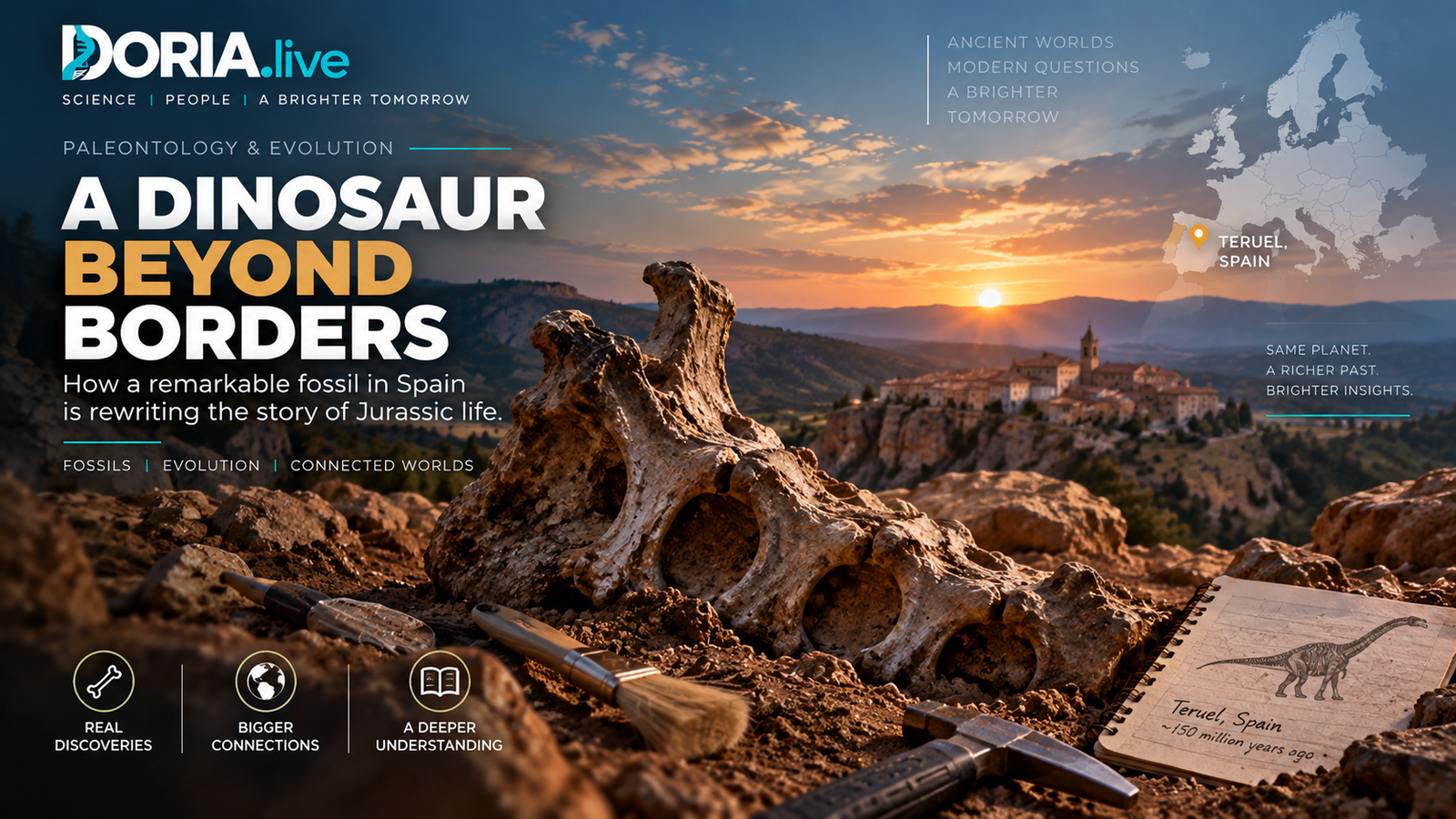
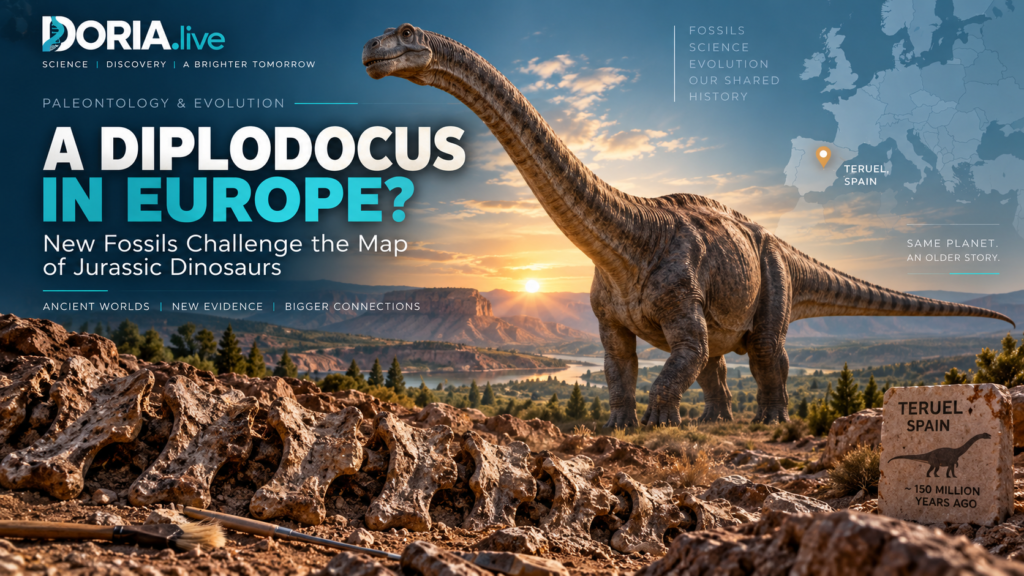
Researchers from the Fundación Conjunto Paleontológico de Teruel-Dinópolis have identified a collection of approximately 150-million-year-old fossils from the La Tejería site in El Castellar, Teruel, as belonging to the genus Diplodocus. The material includes 14 well-preserved tail vertebrae and several chevron bones.
If the identification is confirmed by future research, the discovery represents the first known evidence of Diplodocus outside North America.
The finding also raises broader questions about how large dinosaurs moved between Europe and North America during the Late Jurassic, when the Atlantic Ocean was still in an early stage of formation.
However, the interpretation is not completely settled. Some paleontologists have suggested that the available material is relatively fragmentary and that additional evidence may be necessary to establish the identification with greater confidence.
Description
A familiar dinosaur in an unexpected place
Diplodocus is one of the most recognizable dinosaurs in the fossil record.
The genus belongs to the diplodocid sauropods, a group of long-necked, herbivorous dinosaurs that lived during the Late Jurassic period. These animals had elongated necks, relatively small heads, massive bodies and long tails.
Until now, confirmed Diplodocus fossils were known from the Morrison Formation of western North America.
That made the discovery in Teruel particularly significant.
The Spanish specimen was found at La Tejería, a fossil site near El Castellar in the province of Teruel. The sediments date to approximately 150 million years ago, placing the animal in the Late Jurassic.
The research team identified the remains as Diplodocus after examining their anatomy and comparing them with known diplodocid fossils. The scientific study also included evolutionary analysis to assess the relationships of the specimen.
Fourteen vertebrae tell part of the story
The fossil material consists primarily of elements from the animal’s tail.
Researchers recovered 14 caudal vertebrae along with several chevrons, small bones associated with the underside of the tail vertebrae.
Tail vertebrae can contain important anatomical information. Their shape, proportions and structural features can help paleontologists distinguish between different groups of sauropods.
According to the researchers, the Spanish specimen is comparable in size with several diplodocine specimens known from the Morrison Formation. They estimate that the animal could have reached approximately 25 metres in length.
That would have made the animal a substantial presence in the Late Jurassic ecosystems of Iberia.
Why the location matters
The importance of the discovery goes beyond the identity of one dinosaur.
The fossils provide new information about the distribution of large dinosaurs during the Late Jurassic.
Today, Europe and North America are separated by the Atlantic Ocean. But around 150 million years ago, the geography of the world was very different.
The supercontinent Pangaea was breaking apart, and the Atlantic was still relatively young. The separation between Europe and North America was therefore not the same as it is today.
The discovery of Diplodocus in Spain suggests that members of this dinosaur group were capable of reaching areas on both sides of the developing Atlantic.
The researchers argue that the specimen represents evidence of intercontinental faunal connections between Europe and North America.
Did dinosaurs cross the Atlantic?
The discovery does not mean that a 25-metre dinosaur simply walked across an ocean.
Instead, scientists are considering how land and island connections may have allowed animals to move between regions.
During the Late Jurassic, changes in sea level and the configuration of landmasses may have periodically created pathways or island chains that made movement between parts of Europe and North America possible.
This possibility is consistent with other similarities already recognized between dinosaur faunas on the two continents.
The scientific paper points to several dinosaur groups with representatives or closely related forms known from both Europe and North America, including other sauropods and theropods.
The Teruel fossil therefore adds another piece to an existing pattern rather than creating the idea of transcontinental dinosaur connections from nothing.
Teruel: an important Jurassic landscape
The discovery also highlights the scientific importance of the Teruel region.
The Villar del Arzobispo Formation in eastern Spain contains a diverse Late Jurassic fossil record. Researchers have previously identified remains belonging to sauropods, theropods, stegosaurs, ornithopods, pterosaurs, crocodile relatives, turtles and other vertebrates from these deposits.
The environment was very different from the modern landscape.
During the Late Jurassic, eastern Iberia included coastal and fluvial environments where a variety of animals lived.
The fossils preserved in these rocks allow scientists to reconstruct parts of those ancient ecosystems and understand how different dinosaur groups occupied the landscape.
The new Diplodocus specimen adds another large herbivore to that picture.
A new chapter in dinosaur biogeography
One of the major questions in paleontology is not simply what animals existed, but where they lived and how they got there.
This field is known as paleobiogeography.
Fossils can reveal that animals occupied areas that may initially appear geographically unexpected. Scientists can then investigate whether those distributions resulted from migration, changing climates, geological connections, evolutionary diversification or other processes.
The Spanish Diplodocus discovery is particularly interesting because the genus had previously been strongly associated with North America.
Finding it in Europe expands its known geographic distribution considerably.
It also supports the idea that Late Jurassic ecosystems on opposite sides of the developing Atlantic were more connected than a modern map might suggest.
But is it definitely Diplodocus?
Scientific discoveries often involve interpretation, and this case illustrates why new fossil claims are carefully examined.
The researchers identify the specimen as Diplodocus based on anatomical comparisons and evolutionary analyses.
However, some independent experts have expressed caution.
José Ignacio Canudo, a professor of paleontology at the University of Zaragoza, described the study as valuable but questioned whether the available material—primarily tail vertebrae—is sufficiently diagnostic to establish the genus with complete confidence. He suggested that the broader conclusion about connections between European and North American dinosaur faunas could remain plausible even if the precise classification were revised in future research.
This distinction is important.
The discovery itself is not necessarily invalid simply because scientists may debate the exact classification of the fossils. Paleontology frequently advances through comparisons, reinterpretations and new discoveries that refine earlier conclusions.
Future fossils could strengthen the Diplodocus identification—or potentially lead researchers to reconsider it.
Why more fossils could change the picture
The Spanish specimen consists mainly of tail material.
Additional discoveries would be extremely valuable.
A skull, neck vertebrae, limb bones or other diagnostic elements could provide further information about the animal’s anatomy and evolutionary relationships.
Paleontologists could then compare a broader range of anatomical features with North American Diplodocus specimens and other European diplodocids.
This is one reason fossil sites such as La Tejería remain scientifically important.
A single excavation can produce evidence that raises new questions, while future excavations may provide the material needed to answer them.
A changing picture of Jurassic Europe
The discovery contributes to a growing body of evidence showing that European dinosaur ecosystems were diverse and connected to broader patterns of dinosaur evolution.
Europe during the Late Jurassic was not an isolated biological world.
Different dinosaur groups appeared across regions that were connected through changing geographic and environmental conditions.
The presence of a possible Diplodocus in Spain suggests that large sauropods were able to disperse farther than previously documented.
It also demonstrates how a fossil discovered years ago can acquire new significance when modern analytical methods are applied.
The Teruel remains were discovered in 2008 and subsequently studied before the research was published in 2026.
From fossil discovery to scientific publication
Finding a fossil is only the beginning of a paleontological investigation.
Researchers must document the geological context, prepare the fossils, identify anatomical characteristics, compare them with existing collections and evaluate competing interpretations.
In the case of the Teruel specimen, this process took many years.
The final study was published in the peer-reviewed Journal of Vertebrate Paleontology in September 2026.
The process illustrates how scientific knowledge develops gradually.
A fossil can remain in a collection for years before researchers recognize its full significance. New comparisons, analytical techniques or discoveries elsewhere can change how previously collected material is interpreted.
Conclusion
The discovery of possible Diplodocus fossils in Teruel, Spain, has opened a new chapter in the study of Late Jurassic dinosaur distribution.
The specimen consists of 14 tail vertebrae and several chevrons from sediments approximately 150 million years old. The researchers identify the material as Diplodocus and estimate that the animal may have reached around 25 metres in length.
If the identification withstands further examination, it would establish the first known evidence of this iconic genus outside North America.
More broadly, the discovery provides new evidence for biological connections between Europe and North America during a period when the Atlantic Ocean was still developing.
At the same time, scientific discussion surrounding the classification demonstrates why paleontology is an evolving discipline. Additional fossils and future analyses may strengthen, refine or revise the current interpretation.
For now, the Teruel fossils offer an intriguing glimpse into a world 150 million years ago—when enormous dinosaurs moved through landscapes whose geography was very different from the Europe we know today.