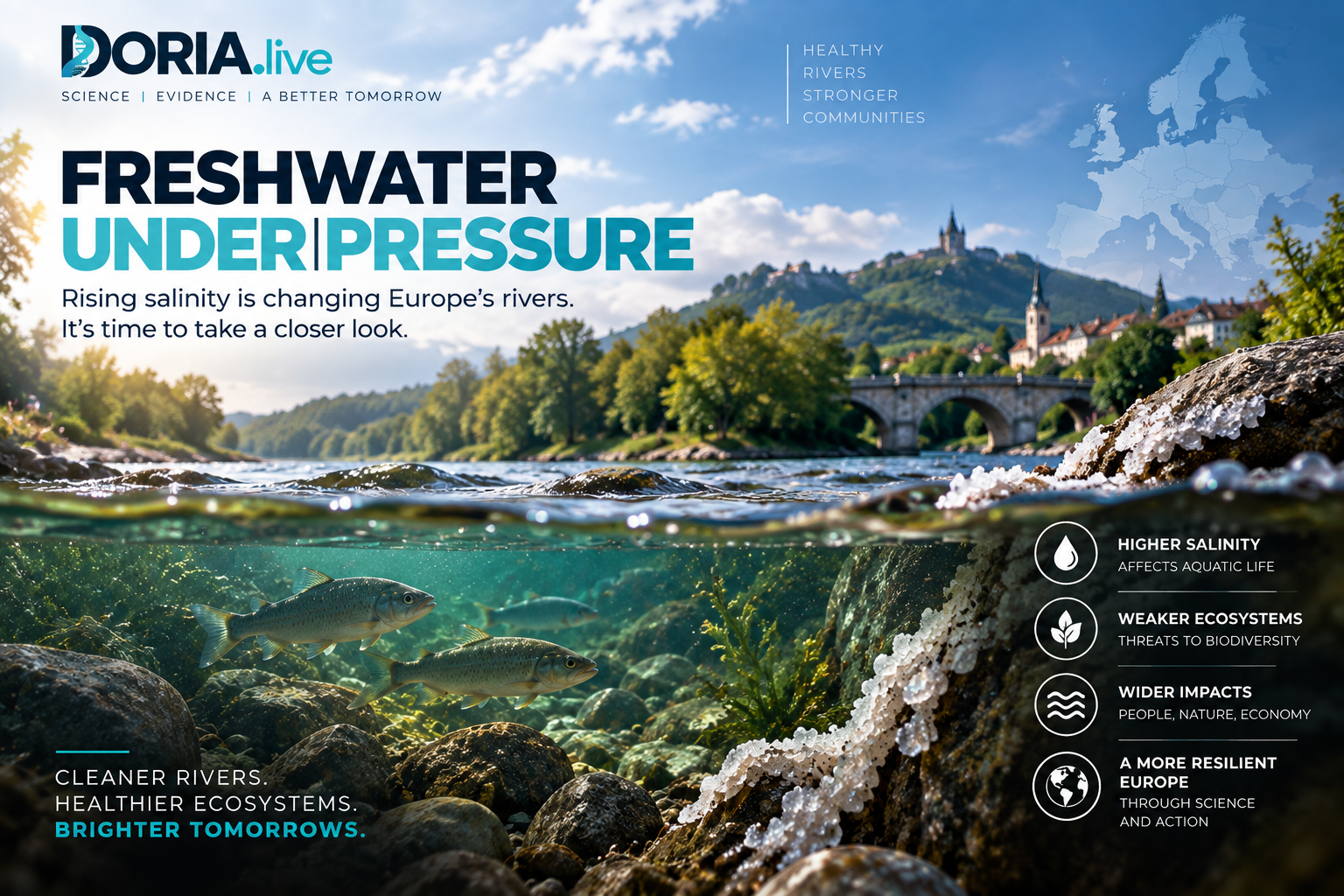
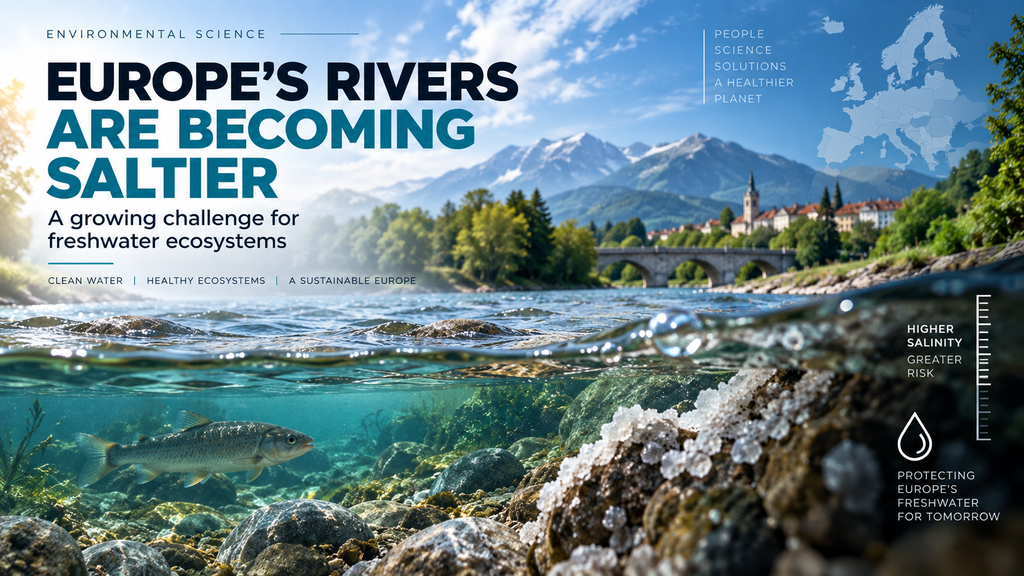
Freshwater ecosystems across Europe are facing a growing environmental challenge that is less visible than plastic pollution or algal blooms: increasing concentrations of salt in rivers.
A recent study published in Nature Communications provides a continent-wide assessment of freshwater salinization in European rivers. Researchers used large-scale environmental data and machine-learning models to investigate changes in river salinity across 35 European countries.
The study found that 28 of the 35 countries with available data contained rivers where salinity had more than doubled compared with baseline conditions. Across the European river network examined, approximately 14% of river reaches showed salinity increases of up to 100%, while another 26% experienced increases of up to 50%.
The researchers also identified more than 23,000 kilometres of European river network where salinity exceeded 1 millisiemens per centimetre, a level associated with concerns for aquatic life.
The findings suggest that freshwater salinization is a widespread European environmental issue rather than a problem limited to a small number of heavily polluted waterways.
Description
A hidden change in freshwater
When people think about river pollution, they often imagine visible waste, chemicals, sewage, or floating plastic.
Salt is different.
In moderate quantities, many dissolved salts are naturally present in freshwater. Rivers continuously receive minerals from rocks, soil, groundwater, and other natural sources. Aquatic organisms have evolved to tolerate the normal range of conditions found in their environments.
The problem begins when salt concentrations increase beyond those natural conditions.
Freshwater organisms, including insects, fish, algae, and microorganisms, can be affected by changes in water chemistry. Persistent increases in salinity can alter the composition of aquatic communities and influence how freshwater ecosystems function.
Unlike a visible pollutant, increasing salinity may not change the appearance of a river. The water can look perfectly normal while its chemical characteristics are changing.
This makes freshwater salinization particularly important to monitor.
A continent-wide investigation
The 2026 study, led by researchers including Julie Crabot and Miguel Cañedo-Argüelles, examined salinity patterns across European running waters.
The researchers used random-forest models to estimate salinity changes at the scale of individual river reaches. Their analysis covered 35 countries where sufficient data were available.
The results revealed a much wider distribution of salinity increases than previous assessments had documented. In 28 of the 35 countries examined, researchers identified rivers where salinity had more than doubled compared with baseline conditions.
Across the European river network, approximately 14% of river reaches experienced salinity increases of up to 100%, while another 26% experienced increases of up to 50%.
The researchers also identified previously underreported hotspots, particularly in parts of Romania and Hungary.
More than 23,000 kilometres affected
One of the study’s most significant findings concerns the scale of river networks reaching elevated salinity levels.
The researchers estimated that more than 23,000 kilometres of European river network, approximately 2% of the total network considered, exceeded 1 millisiemens per centimetre.
The study notes that this level surpasses international standards used for protecting aquatic life. Elevated salinity can contribute to changes in aquatic community structure, disruptions to ecosystem functions, harmful algal blooms, and fish mortality.
The number does not mean that every kilometre of these rivers is severely polluted or that aquatic life is disappearing everywhere.
Instead, it identifies areas where salt concentrations have reached levels that can create ecological concerns and deserve further investigation.
Where does the salt come from?
River salinization can have several causes.
Some sources are natural. Weathering of rocks can release minerals into water, and groundwater can transport dissolved salts into rivers.
Human activity can add substantially to these natural processes.
Road de-icing is one well-known source of salt entering freshwater systems in colder regions. Agricultural activities can also contribute through irrigation, drainage, fertilizers, and changes to soil chemistry.
Mining, industrial activity, wastewater, and urban development can introduce additional dissolved substances into rivers.
The combination of these sources means that salinization cannot always be attributed to one activity.
A river can be affected by several pressures simultaneously, and the dominant source may vary from one region to another.
Why salinity matters to aquatic life
Freshwater organisms live within particular chemical conditions.
When salinity increases, organisms must regulate the movement of water and dissolved substances across their cells. Species that are poorly adapted to higher salt concentrations can experience physiological stress.
Over time, changes in salinity can therefore alter which species are able to survive in a river.
This can have consequences beyond individual organisms.
If sensitive species decline while salt-tolerant organisms become more common, the composition of the aquatic community can change. Because different organisms perform different ecological functions, these changes can influence food webs and ecosystem processes.
The result is not necessarily an immediate ecological collapse. Instead, salinization can gradually reshape freshwater ecosystems.
Salinity and climate change
Freshwater salinization is also connected to broader environmental changes.
Climate conditions can influence river flow, evaporation, soil moisture, and groundwater dynamics. During periods of low water availability, dissolved substances can become more concentrated.
At the same time, changes in precipitation patterns can influence how pollutants and dissolved minerals are transported through watersheds.
This means that salinity cannot always be treated as an isolated water-quality issue.
It can interact with other pressures affecting European rivers, including drought, warming temperatures, land-use change, pollution, and water extraction.
Understanding these interactions is becoming increasingly important as European freshwater systems face multiple environmental pressures simultaneously.
A problem that can remain invisible
One of the challenges associated with river salinization is its lack of obvious visual signs.
A river with elevated salt concentrations may look almost identical to a river with normal chemistry.
This makes long-term monitoring essential.
Scientists need measurements collected over time and across different parts of river networks to determine whether salinity is stable, increasing, or decreasing.
The 2026 study demonstrates how combining environmental observations with statistical modelling can help identify patterns that may not be obvious from individual monitoring locations.
Large-scale models can also help identify areas where additional field measurements would be particularly valuable.
Why Europe-wide monitoring matters
Rivers do not follow political borders.
A watershed can cross several countries, meaning that changes occurring upstream can influence ecosystems downstream.
A regional approach is therefore important when studying freshwater quality.
The European study provides a broader picture than investigations focused on individual rivers or countries. By examining patterns across a large geographic area, researchers can identify common trends while also highlighting regional hotspots.
The results can help scientists ask more detailed questions: Why are some watersheds experiencing rapid salinity increases while others remain relatively stable? Which human activities are associated with the strongest changes? Which ecosystems are most vulnerable?
These questions require further research.
What happens next?
The authors describe freshwater salinization as a widespread but previously poorly documented European challenge.
The new findings provide a baseline for more detailed investigation.
Future research could focus on identifying the dominant sources of salt in individual watersheds and determining how changes in salinity affect specific aquatic species and ecological communities.
Researchers could also examine whether management measures are successfully reducing salt inputs in areas where salinization has already become significant.
Improved monitoring could allow environmental authorities to detect emerging hotspots earlier, before changes become more difficult to reverse.
A broader lesson about freshwater
The story of European river salinization illustrates a broader principle in environmental science: ecosystems can change significantly without obvious visual warning.
A river does not have to become visibly polluted before its ecological conditions begin to change.
Chemical measurements, biological monitoring, satellite observations, and statistical modelling can reveal environmental trends that are otherwise difficult to see.
The challenge is particularly important for freshwater because rivers support biodiversity while also providing water for agriculture, industry, households, and other human activities.
Protecting freshwater ecosystems therefore requires understanding both the visible and invisible pressures affecting them.
Conclusion
A new continent-wide study has found evidence of widespread freshwater salinization across Europe.
Among the 35 countries with available data, 28 contained rivers where salinity had more than doubled relative to baseline conditions. Researchers also estimated that more than 23,000 kilometres of European river network had salinity levels above 1 millisiemens per centimetre.
The findings do not mean that European rivers are uniformly becoming severely polluted. Salinity varies considerably between locations, and the causes differ between watersheds.
What the research demonstrates is that freshwater salinization is a broad environmental phenomenon that deserves greater attention.
As European rivers face additional pressures from climate change, land-use change, pollution, and water demand, understanding changes in water chemistry will become increasingly important.
The future of freshwater ecosystems may depend not only on what we can see in a river, but also on what scientific measurements reveal beneath the surface.