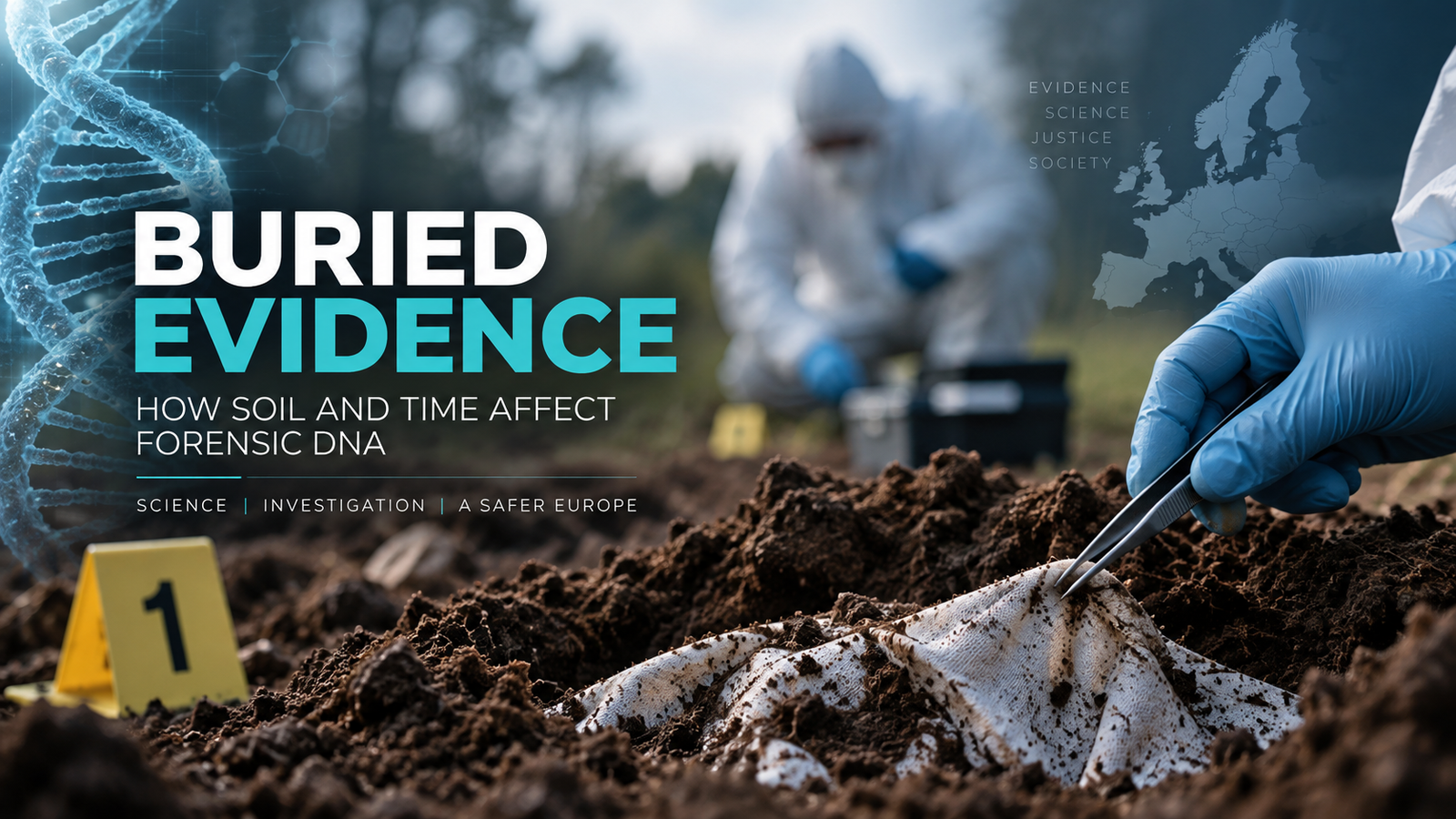
DNA evidence is one of the most valuable tools in modern forensic investigation. Biological material recovered from clothing, objects, or crime scenes can potentially help investigators establish connections between individuals and evidence. However, DNA does not remain unchanged indefinitely. Environmental conditions can affect both the amount of genetic material that survives and the quality of the resulting DNA profile.
A recent study published in the International Journal of Legal Medicine examined how burial affects DNA recovered from blood and saliva samples. Researchers placed biological samples on cotton fabric and compared samples buried in soil with samples left on the soil surface under controlled conditions.
The preliminary results indicated that burial can accelerate the loss of recoverable genetic material. The researchers observed a significant relationship between time, sample location, and biological material, with irreversible loss of genetic material detected in the buried samples within an average of approximately five weeks.
The findings do not establish a universal time limit for DNA survival. Instead, they demonstrate that environmental conditions must be carefully considered when forensic scientists evaluate biological evidence recovered from buried locations.
Description
DNA is valuable, but it is not indestructible
Forensic DNA analysis has transformed criminal investigations. A biological trace left on clothing or another object may contain genetic information that can help investigators establish whether a person may have been associated with the evidence.
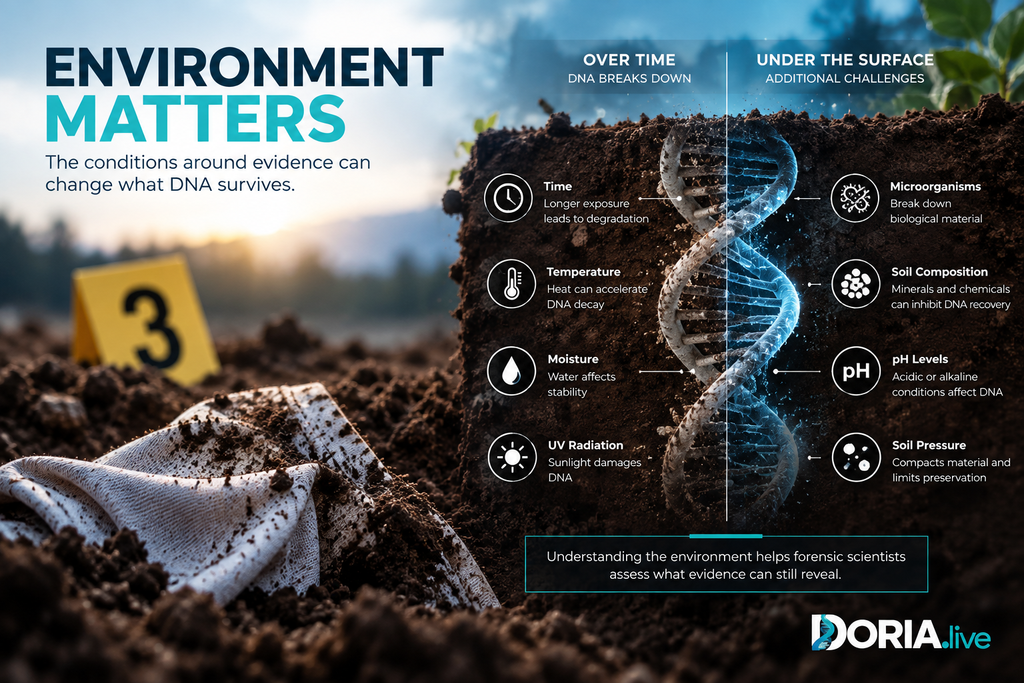
However, once biological material leaves the human body, it becomes exposed to the surrounding environment. Temperature, moisture, microorganisms, ultraviolet radiation, chemicals, and the surface on which the material is deposited can all influence DNA preservation.
Burial introduces another complex environment. Soil contains microorganisms, minerals, organic substances, and varying levels of moisture. These factors can contribute to the degradation of biological material or make DNA extraction more difficult.
This raises an important forensic question: how does burial affect the possibility of recovering useful DNA?
A controlled forensic experiment
Researchers led by Susana Gracia-de-Lucas investigated this question by examining blood and saliva samples deposited on white cotton T-shirts.
The researchers compared samples that were buried with samples that remained on the surface of the soil. They then examined the biological material using genetic-material quantification and autosomal DNA-profile analysis.
The researchers also considered environmental characteristics, including humidity, temperature, and pH.
The study was published in March 2026 in the International Journal of Legal Medicine. Its experimental design provides a controlled way to examine how burial may influence the persistence of biological evidence.
What happened to the DNA?
The study found that burial had a measurable effect on the genetic material recovered from the samples.
The researchers reported a significant interaction between the amount of time that had passed, the location of the sample, and the type of biological material. Most notably, they observed significant and irreversible loss of genetic material in buried blood and saliva samples within an average period of approximately five weeks.
However, this finding should not be interpreted as meaning that DNA automatically becomes unusable after five weeks underground.
The experiment was performed under particular conditions, and the researchers describe the results as preliminary. Soil composition, temperature, humidity, burial depth, biological material, and the surface carrying the evidence can all influence DNA persistence.
A sample buried in cold and dry conditions could behave differently from one exposed to warm and humid soil. Similarly, biological material deposited on cotton may behave differently from material found on metal, plastic, wood, or other surfaces.
The five-week observation should therefore be understood as an experimental finding rather than a universal forensic deadline.
Why the burial environment matters
Soil is a biologically active environment. Microorganisms can contribute to the breakdown of organic material, while moisture and other environmental conditions can influence the stability of DNA.
Forensic scientists must therefore consider more than simply whether DNA can be detected.
There is an important difference between detecting genetic material and obtaining a usable DNA profile.
A laboratory may recover DNA from a sample but still be unable to generate a complete or sufficiently reliable genetic profile. As biological material degrades, the amount of usable information may decline.
The study’s use of both genetic-material quantification and autosomal genetic-profile analysis is therefore significant. It allows researchers to examine not only how much genetic material remains, but also whether that material can contribute to forensic profiling.
Implications for buried forensic evidence
Burial can be relevant in investigations involving objects, clothing, or other evidence that has been deliberately concealed.
When investigators discover buried material, the presence of biological evidence may initially appear promising. However, the age and environmental history of the evidence can affect what a laboratory is ultimately able to recover.
This makes the timing and handling of evidence important.
Investigators may need to consider questions such as:
- How long was the evidence buried?
- What type of soil surrounded it?
- What were the temperature and moisture conditions?
- What type of biological material is present?
- What surface carried the biological material?
- Has the evidence been exposed to contamination?
- Can a laboratory obtain a complete and interpretable DNA profile?
These questions demonstrate why forensic DNA analysis involves more than simply obtaining a genetic sequence.
DNA quantity versus DNA quality
One of the important concepts in forensic genetics is that the quantity of DNA does not necessarily determine the usefulness of the evidence.
A sample can contain detectable DNA while still producing a partial or difficult-to-interpret profile.
Forensic scientists therefore need to consider both the amount of genetic material and the quality of the information obtained from it.
This distinction is becoming increasingly important as modern forensic laboratories develop more sensitive technologies capable of detecting very small quantities of DNA.
More sensitive analysis can improve the ability to recover genetic information, but it also makes careful interpretation increasingly important.
A wider development in forensic genetics
The study of buried biological material is part of a much broader area of forensic research.
Recent international reviews of forensic biology and DNA research have identified developments in areas including rapid DNA analysis, DNA databases, forensic investigative genetic genealogy, DNA transfer and persistence, next-generation sequencing, forensic DNA phenotyping, and human identification.
These developments reflect a changing approach to forensic genetics.
Modern forensic scientists are increasingly interested not only in whose DNA is present, but also in questions such as how DNA was transferred, how long it persisted, what environmental conditions affected it, and how confidently the resulting evidence can be interpreted.
Environmental research is therefore an important part of understanding the complete history of forensic DNA.
Why more research is needed
The researchers describe their findings as preliminary, and the study has limitations. For example, the experiment did not include experimental replicates, meaning that the findings should not be treated as a definitive model for every buried biological sample.
Future studies could investigate a wider range of conditions, including different soil compositions, burial depths, temperatures, humidity levels, biological materials, fabrics, and longer periods of time.
Larger experiments could help determine how consistently DNA degradation occurs across different environments.
Such research could eventually help forensic laboratories better understand the potential value of biological evidence recovered from buried locations.
Conclusion
DNA remains one of the most important forms of biological evidence in forensic science, but its usefulness depends on preservation, recovery, and interpretation.
The 2026 study of buried blood and saliva samples provides preliminary evidence that burial can accelerate the loss of recoverable genetic material, with irreversible genetic loss observed in the experimental samples within an average of approximately five weeks.
The finding should not be interpreted as a universal expiration date for buried DNA. Instead, it highlights the importance of considering environmental conditions when evaluating forensic biological evidence.
As forensic genetics continues to develop, understanding how DNA survives, degrades, and changes in different environments will remain an important area of scientific research.
For investigators, the lesson is straightforward: buried evidence may still contain valuable genetic information, but time and environmental conditions can significantly influence what forensic laboratories are ultimately able to recover and interpret.